Friday, January 27, 2012

Works and Days

Regarding Hesiod's advice on farming and an overall work ethic, I could not help but think of Horace's praise for the hard working ant in Satire I.1.33-39:

"E'en so the ant (for no bad pattern she),
That tiny type of giant industry,
Drags grain by grain, and adds it to the sum
Of her full heap, foreseeing cold to come:
Yet she, when winter turns the year to chill,
Stirs not an inch beyond her mounded hill,
But lives upon her savings"
(Taken from John Conington's translation)


Granted, the context here is different in that it compares the ant's use of a respectable but balanced larder to men who hoard their wealth beyond their need. But the concept of hard work to prepare for hard times certainly reflects the premise that Hesiod presents to his lazy brother, Perses. Furthermore, the tale of the ages of man expands upon what comes of unappreciated and abused wealth as the ages pass from Golden, to Silver, and so on, growing increasingly violent and increasingly removed from the wealth of goods given to them by the gods and earth.

As for the return to two popular myths, that of Pandora and Prometheus, here are a few modern uses of the names:

Pandora - Radio, lumpy looking moon of Saturn, the land of Avatar (the one with the blue aliens, not the animated cartoon).

Prometheus - and Bob (also about an alien - a theme with Classical adoptions of myth? - but this time introducing various technologies to a cave man), upcoming sci-fi movie.

PS: The Penelopiad is now read! The review may be longer in coming than I expected, because it was chock full of juicy details that I want to research properly.

Wednesday, January 25, 2012

Begats and Beatings: Hesiod's Theogony

Creation, according to Hesiod, tumbles forth from nothingness. The Greek is chaos (kah-ohs), a gaping maw, from which deities pour forth and procreate so prolifically that it may seem difficult to keep track. Thankfully Hesiod gives us a hand with such things.

Perhaps this genealogy of the deities makes Hesiod less palatable for borrowers of text.
My first direct encounter with the Classics, I can almost surely say, was the Disney Hercules. And when reading Hesiod, I cannot resist the thought of his begats sung in a fanciful gospel style.

Disney's myth-blundering certainly has quite a few issues (five muses does not equal nine and Hercules was definitely not a child of Hera, and Pegasus was not made from clouds, and Hades did not send the snakes, and... yeah, you get it), but then again, so does the Theogony. Today it was mentioned that many generic mythology introductions base their presentation of the divine beings on the Theogony. The problem with this is that Hesiod's view of the Greek pantheon's lineage is unusal. It spawns Eros of his own accord fresh from the depths of Chaos, and Aphrodite from the "foam" of the sea after Uranus's disembodied genitals are tossed in.

Confused? That's because there are varying accounts as to how these deities came into being. For those wondering, other mythographers have Aprhodite as Zeus's daughter, and Eros/Cupid as her son.

But these varying stories make sense. The ancient Greeks were not a mass-people like we think of countries today. Rather, they were segmented communties who ran into each other, sometimes got along, and sometimes did not. Greece itself was not a unified country until long after Hesiod's works were recorded.

With that being the case, the constant stories of dangerous offspring and conniving mothers makes sense. Not only do individual cults from each city-state vie for attention, but the communities themselves fight for power and recognition by their neighbors. Or, they try to take over their neighbors. Maybe they patch things up with a war-bride or an arranged marriage, which would inherently be political, only for the bride/new mother to assist with a usurpation, or the son.

Sorry guys, no pictures today. Just re-watch that clip from Hercules. In fact, watch all of Hercules, sing along, and then make a list of Things They Did Wrong.

I'll wait.

This may take a while.

Next up, Hesiod's Works and Days! How to be a farmer, and some other stuff.

PS: I am halfway through The Penelopiad, so keep your eyes peeled for a review next week!

Tuesday, January 24, 2012

Homeric Hymn to Demeter

There is a name for stories that describe how the seasons came into being, but I cannot recall or find it. However, I did find this adaptation of the abduction of Persephone.

The myth of Demeter and Persephone is another one I have been familiar with since my (younger) youth. I first read the tale in seventh grade, and while I do not have any specific recollections about my reaction to it, I do recall enjoying the game of "name that deity" that often occurs when reading mythology.

But naming so many deities in this tale has a different effect than other myths. Here, their presence contrasts with Demeter's gradual removal from both divine and human communities while she grieves over the loss of her daughter.

The theme of a grieving mother who removes herself from society is also present in this movie:


While not a direct adaptation of the Hymn to Demeter, the imagery certainly reflects much of Demeter's behavior and the suggested emotional coloring of the hymn.

On the horizon: a review of Margaret Atwood's Penelopiad.

Still on the dark side: Ursula K. le Guin's Lavinia.

The far distant future: Roy Thomas's The Iliad (aka, the Marvel Comics Iliad).

Friday, January 20, 2012

The Odyssey, Part 2: Home at Last

Including a picture of Wishbone in the last post may have been more appropriate than the fact that the series depicts Odysseus, and also a bit ironic.

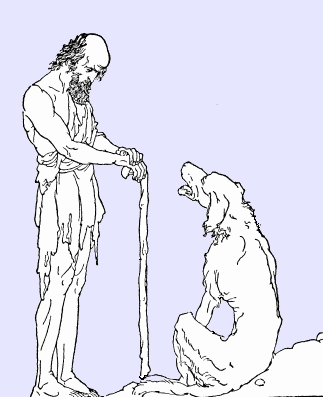
The element that appeared most often in today's images in class were of Odysseus and Argos, his old, faithful dog who sees his master one last time before he dies. So, Wishbone as Odysseus encapsulates that element throughout, depicting a faithful old dog who just wants to go home.


But, Odysseus isn't exactly faithful in all respects. After all, he sleeps with other women along the way, promoting the old double standard. This is, of course, a matter of culture that has its own set of complications and issues, but the broader theme of faithfulness to one's country, particularly as a ruler, certainly stands.

Wednesday, January 18, 2012

The Long Way Home: Homer's Odyssey

My first encounter with Homer's Odyssey was through Wishbone.

Look at that wily dog.

Ever since, I found that stories from the Odyssey were prevalent in my school and daily life. When introduced to Greek literature in middle school, we read about Odysseus and his antics/adventures. Again, in high school, our reliable textbook of international and timeless tales included the cunning of the lost Ithacan king.

Perhaps these stories, with intriguing monsters and action-packed scenes, were used to appeal to a younger crowd bombarded with the equally young Internet, and the Disney-fied fairy tales of heroes and legends.

Doesn't that video cover scream action and adventure?

Even in modern kid's tales involving Greek myth, the Odyssey shows up. Take the Percy Jackson series, for instance. There is a scene where Percy (like Perseus? Get it?) stumbles upon...

Oh yes. Where else to lose track of time and purpose than a casino?

Much of my point, though, is that I feel I seldom encounter the Odyssey as a whole. Modern adaptations pick it apart, choose their favorite scenes, and wedge them into an overarching adventure sequence. The few I can think of that are not explicit adaptations (such as movies and mini-series) are James Joyce's Ulysses, the source for O Brother, Where Art Thou?

Much to my shame as an English/Classics major, I have not read Joyce's Ulysses. But OBWAT certainly triggers the memory of anyone who has read the Odyssey.

There's a cyclops.

There are sirens.


Ulysses has a kind of hubris, in a more American level of vanity.

And, overall, there are adventures. After all, what else are you supposed to do when you struggle to get home?

Friday, January 13, 2012

More War - The Iliad, Part 2

This entry is less about the war, and more about one of its tangential stories.

You see, the whole reason Achilles runs off to his ships in a tiff is because Agamemnon had to give his war prize, Chryseis, back to her father to appease Apollo. Thus, Agamemnon snags Achilles' prize, Briseis, and the Iliad really gets rolling.

Many centuries down the line, we come to a couple of medieval authors who were particularly interested in Chryseis, whose name they wrote as Criseyde, and even later, Cressida. These two authors are Boccaccio and Chaucer. They both write about the romantic tale between Troilus, the youngest of Priam's sons, and Criseyde, who has taken refuge among the Trojans, being the daughter of a betrayer of the Greeks. Since the enemy of your enemy is your friend, she rubs shoulders with her new siege-mates and a nice tale of courtly love ensues. In the end, however, Criseyde returns to the Greeks, much to Troilus' heartbroken dismay, and Troilus runs off to die in battle.

There are numerous images that recall Homer's poetry in each of these new tellings, but a point that always interested me was the twist on war brides. In the Iliad, Chryseis and Briseis are quite clearly interchangeable. Many have pointed out that even their names are quite similar. In Boccaccio's and Chaucer's works, Troilus becomes the interchangeable one. Criseyde swaps her Trojan lover for a Greek one, even bestowing a token from Troilus to her new lover.

This particular twist is meant to highlight the typically one-way path of lover to beloved in medieval courtship. Yet in both ancient and medieval instances, the beloved, or prize, is treated as an object. When considered in the scope of the Iliad, one does not have to go far before arriving at the treatment of Helen. The idea is for Menelaus to win her back. A question that came up in class was whether the Iliad is about winning Helen, or winning Troy. In terms of objectification, there is little difference. Both are things to be won, and in order for the Greeks to obtain Helen, they must conquer Troy.

Wednesday, January 11, 2012

The Iliad, or, That War Thing

Girls, guts, and glory. How many war movies can that phrase apply to?

Okay, so maybe most modern warfare places less emphasis on fighting over women, but there is still talk of the girlfriend/wife back home, and occasionally the bold addition of a war bride, although this final element tends to play less of a pivotal role in the war as a whole. Namely, I do not know of a war story in recent memory that involves a Helen. Or, perhaps, I do not know of a war story old enough to have acquired this kind of legendary mythos.

Yet, there are a great many Patrocluses fighting side by side with Achilles. There are many Hectors who greet their wives and infant children one last time. Priams and Hecubas mourn the loss of their children, one after another, and wait the long days before receiving their children's bodies, if they are so fortunate as to have one.

This article gives one way to look at the Iliad in a modern age of war.

On a lighter note, as mentioned in class, Marvel Comics has an adaptation of The Iliad.


Wrath indeed. Also, note Athena (?) tucked under the shield in the middle ground. Her skirts should probably be hiked up for the battlefield. Maybe her goddess powers keep her from tripping.


I want to read these, now. Despite the demure pose, I do like that the woman on the left (Helen, perhaps?) is not given an overly sexual treatment. Also, it looks like she's up to something.

Monday, January 9, 2012

Dig(itize) the Classics

Classics. What a weighted topic.

There's a look that passes over another person's face when you announce that you study things like Classics, Latin, or Greek. Especially if they are not familiar with the humanities, and sometimes even if they are, they question the relevance of such topics in a digital age. Somehow, they are surprised when they hear that Classics has ridden the digital wave from early on, and that the electronic materials available to a student of the Classics vary as much as they do.

My standing question for this course turns to the texts, the very literature I study, either in its original language or in translation. How does the availability of these works add to the conversation of literary criticism and interpretation? I suppose that, from an academic standpoint, I should also ask, how does criticism differ from interpretation? Is it simply a matter of the medium used, whether prose, poetry, painting, sculpture, music, dance, or acting? Are there media in that list that I have missed, perhaps that have yet to be invented?

It may be a difficult task, certainly one that will last a lifetime, but I want to see what I can dig up about the reception of Classics on the Internet.